If you run an outbound floor, you already know the math: a call from a 312 number lands differently on a Chicago consumer's phone than a call from an 800 or an out-of-state code. The question isn't whether local presence works — it's how to source enough of the right area codes, rotate them when they get flagged, and keep your cost-per-connect from drifting up every quarter.
This post is about the buying side of that problem. How many numbers per area code you actually need, what to demand from a DID supplier, and how to keep the inventory healthy once it's live.
Why area code match still moves answer rate
Consumers screen. They've been trained by years of spam to ignore unfamiliar numbers, and the single strongest "this might be someone I know" signal on a locked screen is a matching area code — sometimes a matching prefix. You're not tricking anyone. You're clearing the first filter so a human gets the chance to decide whether to pick up.
The lift varies by vertical. Debt collection sees different numbers than B2B sales, which sees different numbers than political GOTV. But the direction is consistent: in-state beats out-of-state, in-NPA beats in-state, and matching prefix (NPA-NXX) beats matching NPA alone when you can get it. Toll-free is the floor for cold outbound to consumers.
A few honest caveats:
- STIR/SHAKEN attestation matters more than it used to. A matching local number with B-attestation can still get tagged as Scam Likely on the carrier side. Local presence is necessary, not sufficient. See our notes on answer rate and spam flagging.
- Burn rate is real. A number used hard for one campaign can be cooked in days. You need replacement inventory, not a static block.
- Some area codes are saturated and don't actually feel "local" anymore — overlays in major metros mean a 646 doesn't read as NYC the way 212 does. Buy with that in mind.
How many numbers per area code do you actually need?
The honest answer: more than you think, and the right number is a function of dials per number per day, not headcount.
A rough way to size it:
- Decide your ceiling on dials per number per day. Most floors land somewhere between 50 and 150 before flagging risk climbs sharply.
- Multiply your daily dial volume in that NPA by your campaign days.
- Divide by your per-number ceiling. That's your working inventory.
- Add 30–50% for rotation as numbers get flagged and rested.
For a mid-size center calling into 40 different area codes, you're easily looking at thousands of DIDs in active rotation, with a parallel cold pool resting. This is why "buy a hundred numbers once" isn't a strategy — it's a starting position.
What to actually ask a bulk DID supplier
When you're sourcing at volume, the line items that matter are not the ones on the homepage. Get on a call and walk through these:
Area code coverage. Can they actually fill an order for 200 numbers in NPA 814, or are they going to come back with 40 and apologies? Ask for a coverage map or a live inventory check before you commit. Rural NPAs and recently-overlaid metros are where suppliers quietly fall short.
Order turnaround at volume. A 500-number order should activate same-day or next-day, not in a week. If the answer is "we'll get back to you," assume that's also the answer when you need to replace burned numbers mid-campaign.
Rotation and replacement policy. When a number gets flagged, what's the process? Self-serve in a portal, a CSV upload, or an email to support? At volume, anything that isn't API or bulk-CSV is going to break you.
Port-in and port-out. If you're bringing existing inventory, how long does port-in take and what's the FOC commitment? More importantly: can you port out cleanly if you leave? A supplier that makes port-out painful is telling you something.
Pricing structure. Don't accept a single blended number. Ask for the line items separately — per-DID monthly, per-minute origination, any 911 or regulatory fees, and what changes at commit tiers. Then compare apples-to-apples across two or three suppliers. Our bulk DID checklist for small resellers covers the contract side in more depth. Also ask how they handle registering CNAM across bulk inventory — if it's a per-number manual process, that's a real operational cost at scale.
What happens when something breaks. Who do you call at 2pm on a Tuesday when half your inventory stops completing? If the answer is a ticket queue, walk away.
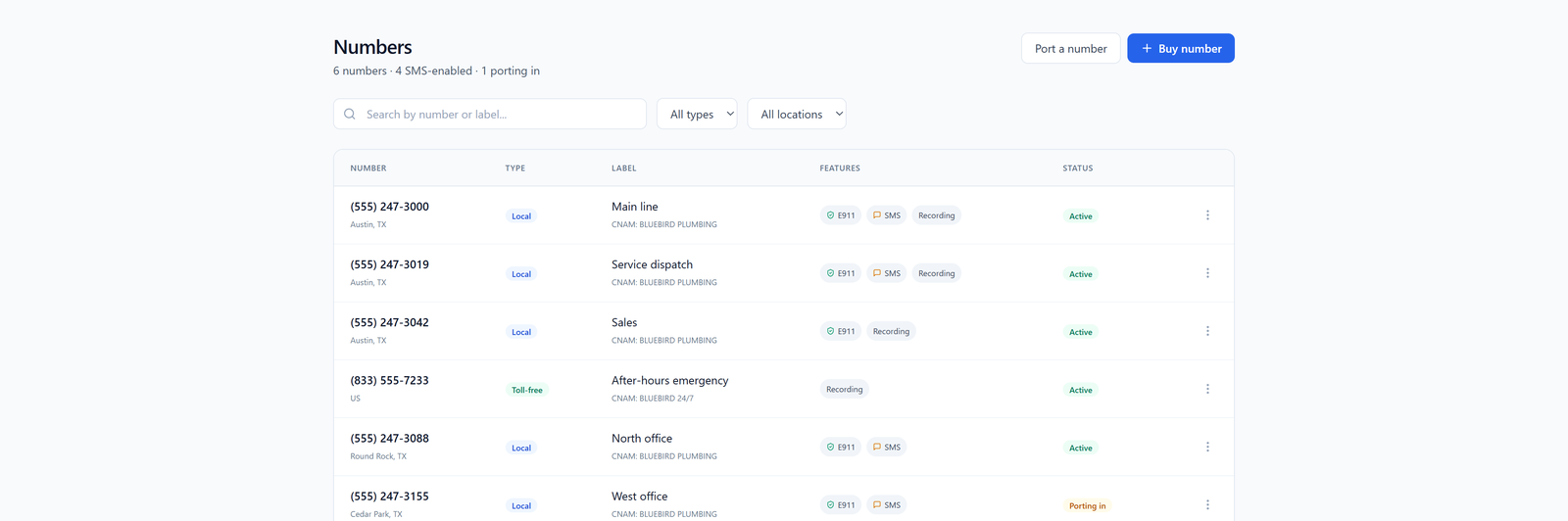
Managing the inventory once it's live
Buying the numbers is the easy part. Keeping the pool healthy is the work.
Rotate based on signal, not schedule
A fixed "rotate every 7 days" rule wastes good numbers and overuses bad ones. Track per-DID:
- Answer rate over the last N dials
- Spam-tag status from a monitoring service (Hiya, Nomorobo, free-caller-registry lookups)
- Completion rate vs. your floor average
When any of those drop below threshold, the number goes to the rest pool. Bring it back in 30–60 days and re-test. For specific swap thresholds and how to size the reserve pool, see our walkthrough on rotating flagged numbers.
Match prefix, not just NPA, where you can
If you're calling 312-555-XXXX, a 312-555 originating number reads more local than a 312-867. Some suppliers let you request specific NXX prefixes — ask. It's not always available, but when it is, it's free lift.
Don't let a single campaign monopolize a number
If your collections floor and your sales floor share inventory, and collections burns a 404 in three days, sales just lost a 404. Segment pools by campaign type. Treat them like separate budgets.
The compliance layer you can't skip
Local presence is a caller ID strategy. It doesn't exempt you from TCPA, state-specific do-not-call lists, or carrier-level analytics. A few practical reminders:
- Your outbound CNAM should match the entity on record. Spoofing a number you don't own is a fast way to lose your termination.
- STIR/SHAKEN attestation is set by your originating carrier. If you own the DIDs through your supplier, you should be getting A-attestation. If you're not, ask why.
- Register your numbers with the free caller registries. It doesn't guarantee clean delivery, but unregistered numbers flag faster.
- For political work, the rules are different and the windows are short — our political dialer deliverability checklist goes through it.
What to do next
If you're sizing a buy:
- Pull your dial volume by NPA for the last 30 days. That's your demand curve.
- Set your per-number daily ceiling based on your vertical's flagging risk.
- Calculate working inventory plus 30–50% rest pool.
- Send the NPA breakdown to two or three suppliers and ask for coverage, turnaround, and a line-item quote. Don't accept blended pricing.
- Test a small order against a real campaign before committing to the full volume. Measure answer rate per supplier, not just per NPA.
The suppliers who can actually deliver will answer your questions on a call in one sitting. The ones who can't will send a PDF and ask for a meeting next week. You'll know inside ten minutes which one you're talking to. When you're ready to compare, our bulk DID page is a reasonable place to start.