If you're buying numbers in volume for outbound, the DID-vs-toll-free question isn't academic — it shows up in your answer rate, your flagging rate, and how often you're rotating inventory. Most ops teams already have an instinct here. This post is for the moments when the instinct is wrong, or when you're staffing a new campaign and need to defend the buy.
Short version: local DIDs win almost every cold outbound use case, toll-free wins for inbound callback and specific regulated scenarios. The interesting work is in the edges.
What each number actually signals to the person you're calling
When a consumer's phone rings, the caller ID is doing most of the work before they decide to pick up. A local number that matches their area code reads as "someone near me" — a neighbor, a local business, a school. A toll-free number reads as "a company is calling me," and for cold outbound that's usually a signal to ignore or block.
That one perception gap drives most of the answer-rate delta. It's not magic, it's not STIR/SHAKEN, it's not the dialer. It's the screen on the consumer's phone.
Toll-free has the opposite property on inbound. If you've put a toll-free on a billboard, a mailer, or the back of a debit card, people expect to see it when you call them back. A local number in that scenario looks suspicious.
Cold outbound: buy local DIDs in bulk
For sales prospecting, lead qualification, debt collection on cold files, GOTV, surveys, and any campaign where the consumer has no prior relationship with the number you're dialing from, you want local DIDs that match the destination area code. The math is consistent across every dialer report we've seen: matched-area-code DIDs outperform toll-free on connect rate by a wide margin, and outperform mismatched DIDs by a meaningful margin too.
A few practical points:
- Buy by NPA/NXX, not just state. A 312 number calling a 773 consumer is fine. A 312 number calling a downstate Illinois 618 consumer is not really "local."
- Plan for rotation. Local DIDs flag. You will burn through inventory. Size your buy assuming a portion of any block will degrade within weeks of heavy use, and have a process to swap them out — not a three-day email chain with your carrier. For specifics on swap thresholds and reserve pool sizing, see when to pull a flagged number and how big your reserve pool should be.
- Watch your attestation. A great local DID with B-attestation from a sloppy upstream is worse than a clean A-attested number. We've written about attestation health checks for buyers running at scale.
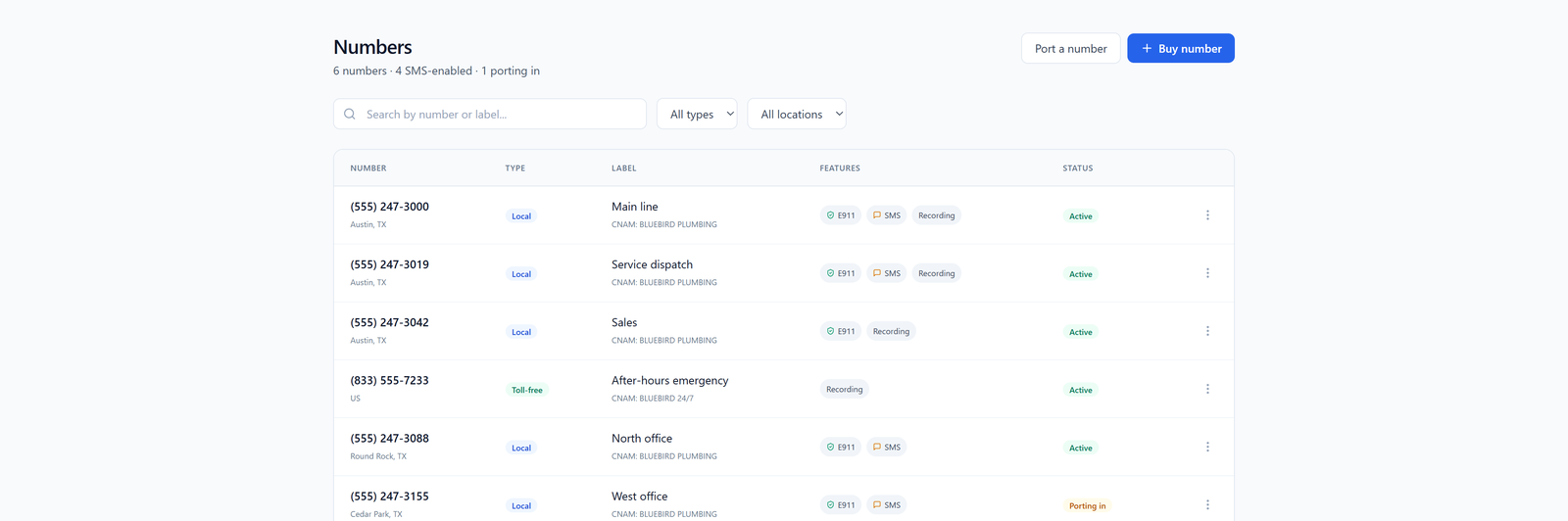
When local DIDs are the wrong call
There are exceptions. If you're operating under a regulator or client contract that requires a single published callback number, you can't rotate through 500 local DIDs and meet that obligation. If your brand is the entire pitch ("Hi, this is BigBank"), a recognizable toll-free that matches your published number may convert better despite a lower answer rate, because the people who do answer trust you faster.
Toll-free: callback, inbound, and specific compliance lanes
Toll-free numbers earn their keep when:
- The consumer initiated the relationship and expects to see your published number.
- You need a single, stable, nationally-recognizable callback that survives marketing channel changes.
- You're in a regulated vertical where the published number on a disclosure must match the dialing number on outbound contact attempts.
- You're doing IVR-heavy inbound at volume and want the cost structure to land on you, not the caller.
Toll-free also has a different reputation system. RND (Reassigned Numbers Database) doesn't apply the same way, toll-free SMS goes through a separate verification process, and toll-free spam labeling works differently from CNAM-based labeling on local numbers. None of that makes toll-free magically clean — toll-free numbers absolutely get flagged — but the failure modes are different and the remediation paths are different.
Mixed-fleet campaigns: when you want both
Most serious outbound operations run a mixed fleet. The pattern that works:
- Outbound dial from rotated local DIDs, matched to the destination NPA.
- Publish a single toll-free as the callback in your voicemail drops, agent scripts, and any compliance disclosures.
- Route inbound on the toll-free into your queue, with caller-ID lookup so the agent sees who's calling back and from which campaign.
This gets you the answer-rate lift from local presence on outbound and the consumer-trust signal from a stable callback on inbound. The cost is a little more routing complexity, but any modern phone system handles it without drama.
What to ask your provider before you commit
Whether you're buying 50 numbers or 5,000, the questions are the same and the answers separate the serious wholesale providers from the resellers playing dress-up:
- Activation time on a bulk order. Hours, not days. If they need a week to provision 500 DIDs, walk.
- NPA/NXX coverage. Can they actually fill the area codes you need, or are they going to substitute "close enough" numbers from a neighboring NPA?
- Attestation on outbound. A-attestation, end-to-end, from your dialer to the terminating carrier. If they hedge, that's your answer.
- Rotation policy. When a number flags, how fast can you swap it? Is there a self-serve process or do you file a ticket?
- Port-in handling. If you're moving an existing block, what's their realistic turnaround, and what do they do when the losing carrier puts the port on hold?
- Toll-free responsible org changes. If you're moving toll-free in, who's the RespOrg of record and how do they handle the swap?
- Pricing model. Per-number, per-minute, monthly minimums — get the full rate sheet, not a headline number. Compare line items, not summaries.
What to do next
If you're standing up a new outbound campaign: figure out your destination NPA distribution from the dialing file, buy local DIDs to match, and put one toll-free behind it as your callback. Build the rotation process before you need it, not after half your inventory is flagged.
If you're auditing an existing campaign with answer-rate problems: check the attestation on your outbound traffic first, then check whether your "local" DIDs are actually matching the consumer's NPA, then look at how stale the inventory is. The answer is almost always one of those three.
And if you're shopping providers, the rate sheet matters less than the operational answers above. A cheap number that takes a week to activate and never gets rotated when it flags isn't cheap.